Seeing Auras; Ascribing Meaning
Sensory Experience vs. Moral Evaluation

I see auras. And also, I pay no attention to them. For most of my life I presumed it was a defect with my eyesight or brain or both -- which by the way, that’s most likely it.
That said, medical explanations don’t take away from the spiritual implications, at least not for me. Ocular migraines and severe astigmatism are both known to cause a person to see a halo-like glow around people. Chronic dry eyes and corneal irregularities compounding ocular migraines and astigmatism can then make the glow appear to bear color.
Synesthesia can also be another culprit for what we think of as seeing auras. Your senses get cross-wired, so you see color when you hear sounds, hear musical notes when you see colors, and feel notes and numbers on a musical scale in different bones; likewise, someone’s presence — which we can all sense, it’s the “vibes” you get off a person — can get color-coded, and that’s the aura color a synthesthete might see.
Having not just one or some but all of the aforementioned conditions is probably why, medically speaking, this is what I see when I look at people:
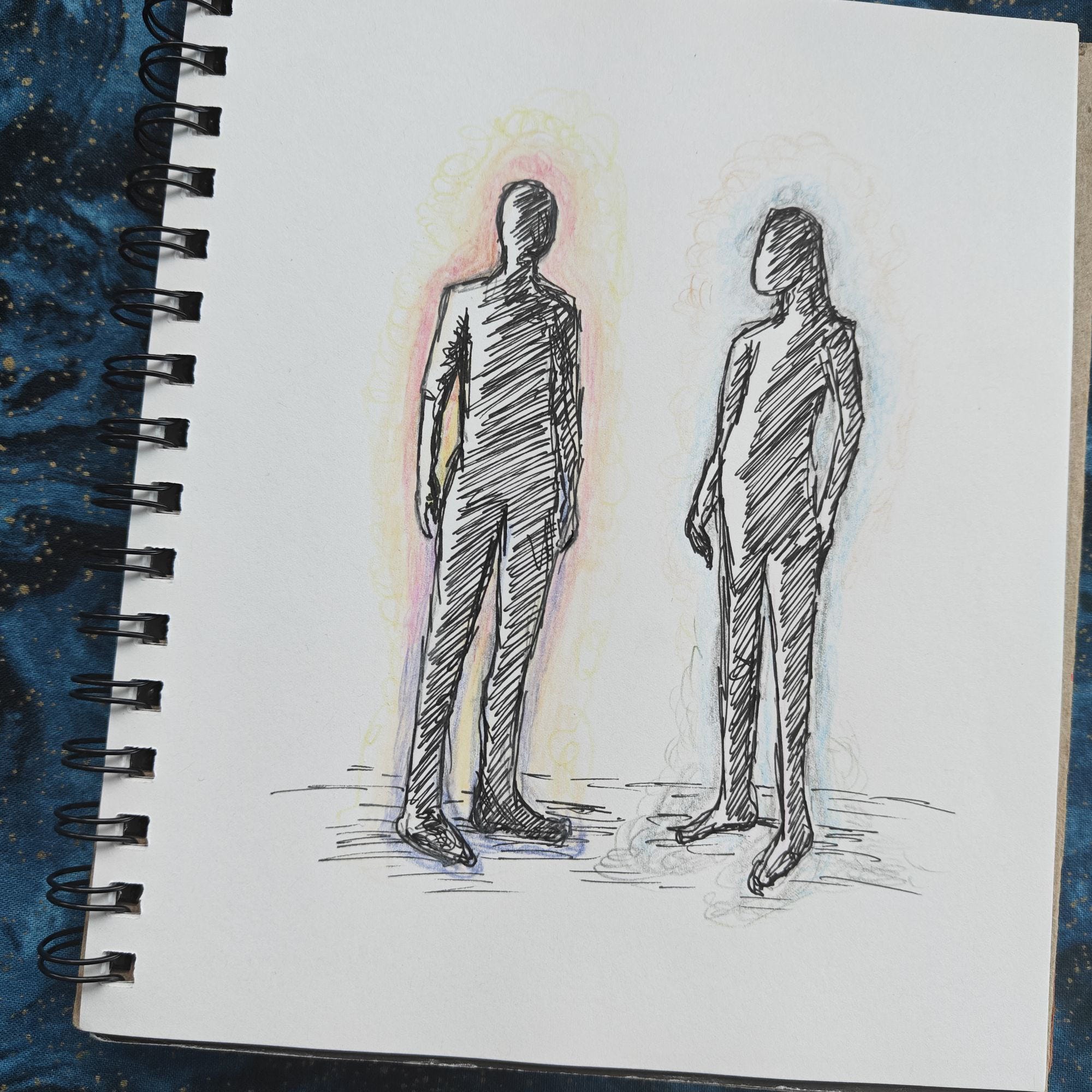
Or at least when I make an intentional point to look. I don’t usually pay attention to people’s auras. That’s probably just a me thing, however, as I find I can be face to face with someone for hours, walk away, and have no recollection of what color shirt they had on. I don’t typically pay attention to eye color or shoe color. Likewise, I don’t pay attention to people’s auras. It’s only when I’m being asked to look and to be intentional about it do I see it.
Although… girlies often do this with fellow girlies, where you are going to compliment someone who’s remarkably pretty, like, “Omigod, you have the prettiest eyes!” It’s not a matter of intentionally checking out people’s eye color, but sometimes you just meet someone and you feel compelled to share with them, my goodness, you have the loveliest most winsome smile! So yeah, I acknowledge I have at times done that with auras. Billows of efflorescent color are a beautiful sight to behold (the most beautiful auras are when they look like those halos you see at night around street lights, tinged with jewel-like colors), and just like noticing someone wearing a really cute dress that they look great in, sometimes I’ll comment on a particularly radiant aura.
Fortunately, most of the time they think I’m just using a figure of speech. =D
Auras, in case they need an explanation, are subtle, luminous fields of glow that can emanate from living beings. It looks like a translucent, shimmery, wavy distortion in the air surrounding a person. Focus your eyes a bit and then you start to see color. Sometimes it’s very pale, almost with a grayish tint to it. Other times it’s bright, lustrous, and you can even feel it, like a palpable force field. Often it’s just that translucent haze, like seeing heat rising from concrete on a hot summer day, and with the tips of the rays frosted a certain color. There are a few people I’ve encountered who have an aura like a poisonous force field, where you feel sick if you are in close proximity for too long. (This is why you need to shield, blah blah blah, yeah yeah.)
Dating back to the Han dynasty (200 BC to 200 AD), we have Taoist texts describing the colors and glow of Qi and/or Shen that can radiate from the human body. Qi is your vitality and verve, the force you possess for driving dynamic action. Shen is like a heightened level of consciousness or your level of awareness and thus mindful control over what you’re doing. Qi is ascertained by the intensity, chroma, and strength of the aura; Shen in the hues and values of the colors.
Adepts who have undergone training and cultivation are able to assess a person’s Qi and Shen from looking at the aura. So if you want to see if a certain spiritual teacher is legit, just look at their aura (allegedly). A person’s aura will reveal their practiced virtue and attainments in energy cultivation, and lacking of practiced virtue or weak, chaotic energy also gets revealed. And also (allegedly), any spiritual practitioner worth their salt can see auras and spot bona fides and frauds through their auras.
At least that’s the conventional wisdom among Taoist practitioners, which I’m not saying I believe or don’t believe. It’s maybe more nuanced than that. (I say that while simultaneously and hypocritically getting a bit tired of people throwing around the word “nuance.” Everything is “nuanced” but nobody’s rhetoric actually is.)
When I was in junior high there was this martial arts Taoist shi fu (teacher) guy, who I believe was famous (!!!). People addressed him as shi fu (meaning “master teacher”), but Mom said I should just call him Gege (“elder brother”). So he was just Gege to me.
Anytime I get in a discussion on auras, I recall this exchange with Gege. He was telling me about my aura and what it meant, and I thought, oh, I didn’t know we could talk so openly about people’s auras. (I had thought maybe there were etiquette rules around talking about auras because no one ever did).
While he said very kind and generous things about my aura, he was saying less kind and generous things about other people’s auras, judging people by the aura’s colors, intensity, that kind of thing. His purpose for raising the topic of auras was to talk about my karma and past lives (a story for another time I suppose). But I was too hung up on wanting to know, how can you do that? How do you judge a whole person’s life story, let alone their so-called past life stories, by their aura that day, that hour?
So I pushed back. I said aura colors and even how visible they are can fluctuate based on the person’s mood that day, even as temporary as a mere moment. Hell, I can shrink my aura or make it real big at will, kind of like posture, I can sit up tall, chin up, shoulders back, and pretend to be confident when I’m totally not, or I can slouch and come across appearing blah, because I am intentionally trying to make myself look small and unassuming.
Also, I said I wasn’t quite sure that one person’s blue aura meant exactly the same thing as another person’s blue aura, so then if I can’t even standardize what a blue aura means, how can I judge a person for having a blue aura? And sure, most people have a default setting for aura color, but if I’m meeting someone for the very first time, how am I to judge what that default setting aura color is? Today it’s blue for reasons, but maybe it’s typically red, how would I know.
Not to mention, him rattling off about my aura, certain aunties’ auras, when no one asked, or certainly I did not, also got me questioning whether that was even ethical. Judging people by their auras makes me uncomfortable and does not pass my vibe check. Judging people by their eye color, hair color, skin color, or even by things like blood type or astrological sign has never sat right with me. I’m not saying I don’t subscribe to natal astrology, clearly I do, given that I’m an astrologer. What I mean is we shouldn’t be judging someone’s character by their natal astrology.
He looked amused, excited, and also, strangely validated. You can see auras! Of course you can! He then asked me to read his aura. I did, and because I’m an overachiever, I also told him about some other intangibles I was seeing and sensing. See the difference? He asked. It was solicited. If he didn’t explicitly invite me to do it, I wouldn’t. I’d have kept my impressions to myself.
“What you’re seeing about me, and sensing, what do you think it means?” he asked, clearly testing me. Bro, didn’t I just say I don’t think we should be judging people by physical traits? Not that I’m certain that auras count as “physical” traits, but I just don’t think I have enough universal baseline data to judge what a particular aura means. A big bright aura means they’re feeling great that day; a more faded one means they’re not. I don’t see how that has any relevance on their character.
“But someone who has mastered spiritual cultivation can maintain a big bright aura even when they’re sad,” he said to me.
We’ve now arrived at the first point for discussion. Do you agree?
I mean, let me clarify. I would say sure, I agree as a matter of theory, but I don’t know that I agree as a matter of realistic practice, and let me explain what I mean by that. Just because you allow yourself to feel feelings, emanate with sadness when you’re sad, emanate with anger when you’re angry, I don’t see how that makes you any less “spiritual” than someone who’s an unmoving wall of zen.
His questioning continued. “Have you ever seen any of the shi fu (other master teachers) with a grayish cloudy aura? Or do you notice a pattern in the character of people who you see having that grayish cloudy aura?”
It’s true, to the very limited extent I’ve been able to observe, legit shi fu have big, bright glowing auras. I’ve never seen one, who was legit, with a grayish cloudy aura. But maybe being a tween meant I wasn’t about to give him that satisfaction.
“I just don’t see how somebody’s grayish cloudy aura is any of my business,” I said. “Unless they share that with me and invite it to be my business.”
“If you see a spiritual teacher trying to lead people down a particular path and you can see that person has a grayish cloudy aura, what would you do?”
“I would stay away from that person.”
“Nothing else? You would do nothing else? You wouldn’t say anything to prevent other people from getting led astray?”
There’s our second point for discussion I suppose. Would you?
I wonder if how we think through that question is not unlike the Trolley Problem in classical philosophy: if there’s a runaway train down the tracks about to hit and kill five people but you have control over a lever that can divert the train to a side track that will only kill one, do you pull the lever for the greater good (saving more lives, five vs. one) or do you do nothing (because first, do no harm, and it’s not your place to decide)?
Oof, that’s a tough one for me. My final answer to the Trolley Problem is I would do nothing, because first, do no harm, and it’s not my place to decide, even if it means this is going to weigh on my conscience for the rest of my life, and that’s the burden I’ll bear for choosing to do nothing.
Also, whether you would judge a spiritual teacher’s sincerity/abilities by their aura depends on how you interpret auras. Because personally? I don’t think that information is all that useful.
There seems to be this prevailing view - especially among spirituality communities - that aura reading is like a diagnostic tool - you can use it to ascertain someone’s spiritual development and the character of their subtle energy bodies.
Whereas is this kind of like pretty privilege? Like judging whether someone has good karma by how pretty they are? We all see how people’s competencies get unfairly judged all the time by whether they have pretty privilege, and we know that is very, very bad decision-making. Are we seriously going to judge the content of a spiritual teacher’s character by whether or not they have aura privilege?
All that is why no, I would not say anything to anybody about what I see in another person’s aura. Because at the end of the day, I just don’t know what that aura means. Indulging my own ego to believe I know what it means and then telling other people about it seems like bad decision-making.
While sure, I have never personally seen a spiritually transcendent master teacher with a grayish cloudy aura, I also don’t know as a matter of fact what that indicates. To take that and then leap to wild conclusions is where I differ from Gege, and by extension, the majority of mystics.
To be fair Gege wasn’t telling me to shout anything from any rooftop. He was just trying to teach me how to be wary of certain types of people in the types of communities he anticipated I would encounter in my life ahead.
That’s actually what inspired this post. I’ve been reflecting on Gege’s teachings and realizing that three decades later I still don’t know how to navigate these waters. If I see someone in our community holding themselves out with a particular authority whereas I can see their aura, have seen their aura many times now and have a sense for their baseline, even if I don’t shout anything from the rooftops, to what extent do I “keep it to myself”? Do I tell nobody? I do nothing at all? Just drop it? Pretend I saw nothing?
Before tackling whether I have a responsibility to say or not say something about someone of authority’s aura, there’s the deeper issue of whether aura perception is even an objective verifiable phenomenon. There’s no rational or scientific basis for it, goes popular convention.
Do I even know whether seeing auras is a stable enough objective reality? Is assessment of someone’s blue aura more like how I like to interpret the tarot Moon card in a reading or is it more like Traditional Chinese Medicine holistic health diagnostics? What category of experience does seeing auras belong in?
Seeing aura colors is my reality, and sourced from my vision, so it’s more about me than it is about that other person. I speculate that the aura I see in another has more to do with my relationship dynamic with that person than any objective, fair commentary about that person as a character. Therefore no, Gege, I would not say anything to anyone if I saw a master teacher with a cloudy gray aura; it would be nothing more than a signal to me only to stay away.
I anchor myself with the understanding that the root cause of me seeing auras is because I’m a synesthete with an irregular cornea and retinal malfunction. Grounding my subjective experiences of seeing auras in plausible physiological and psychological causes keeps me sane. And personally, I think it’s an important mental exercise for spiritualists, especially for spiritualists, to do.
I see way too often spiritualists rejecting physiological and psychological explanations. They immediately default to the most extravagant mystical interpretation possible. “I can do X because I am spiritually enlightened and specially tasked by the gods to do X, this is my calling” rather than temporal lobe hyperactivity or stress-induced dissociation.
To circle back to the top, the spiritual implications of seeing auras. I don’t assign any spiritual significance to being able to see them, and to the extent that the auras I’m seeing hold meaning, it’s only information I need to know for myself, privately, about how I should or should not engage with that person. What I see in another person’s aura is a data point for calibrating my own boundaries only, not a verdict on their spiritual standing.
If auras speak, they speak only to the person who is seeing them, and carry a message only for that seer alone to know.
Perhaps it could be likened to apparitions, synchronicities, or even UFO sightings—all of which (at least to me) seem real as experiences but do not always have a manifestation in consensus reality.
I love the point that they are, regardless, meaningful to you as the individual. If I saw an apparition of a deceased ancestor, the point is that it would be significant for me, not that someone else could confirm it.
Im so impressed that junior high Belle recognized the ethical implications of what Gege was doing! Im not surprised, but as always, very impressed